

To read our full disclaimer, click here.
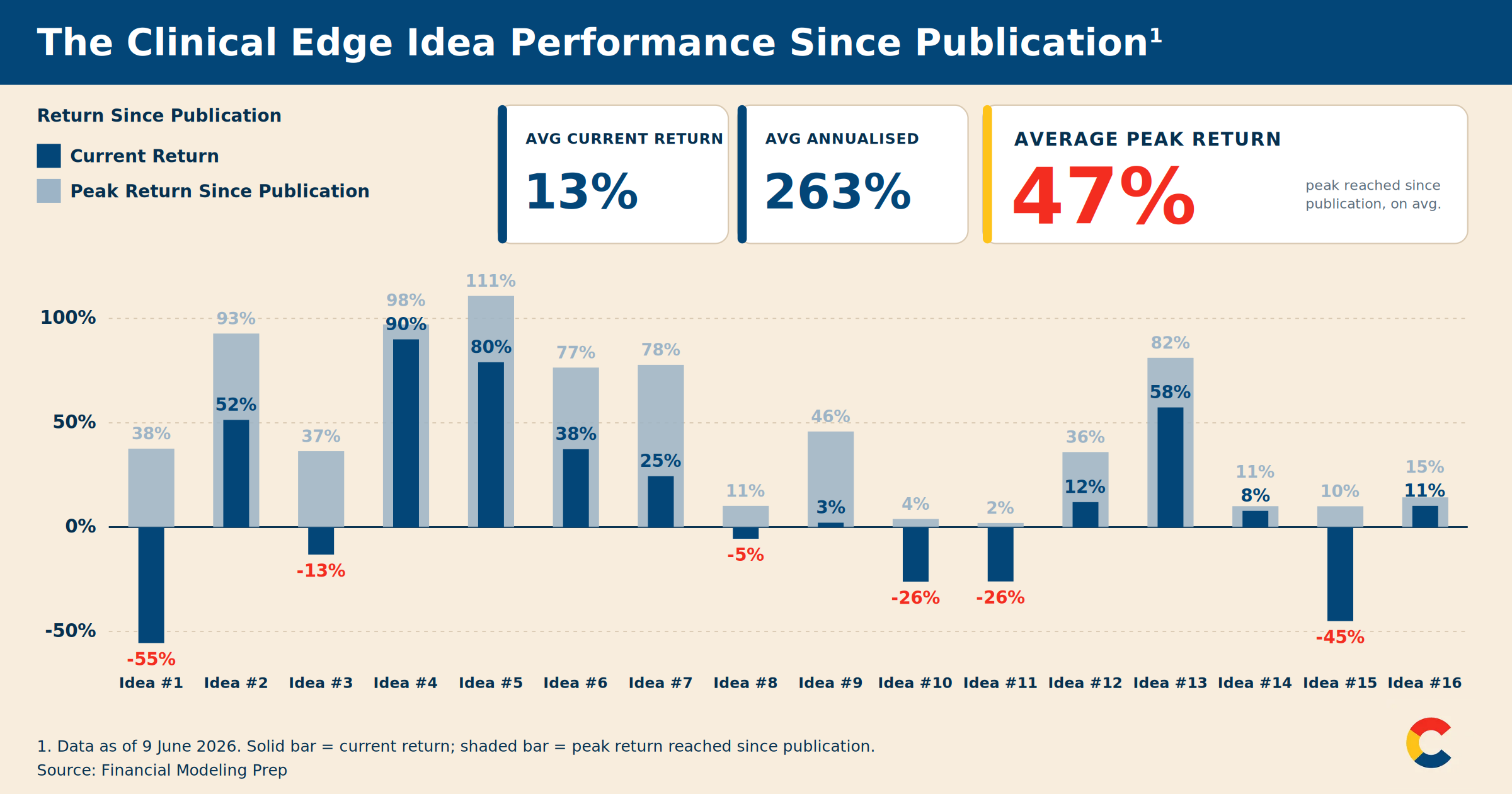
The track record so far:
16 ideas published.
47% average peak return since publication. Not the best one. The average.
6 of the 16 - 38% - up 75% or more at some point.
Average idea is 155 days old. Five months. The newest is 26.
Below is a short thesis summary of my favourite 10 ideas in random order.
A few are free for everyone to read; most sit behind the paywall, where you also get every new idea as it’s published and ongoing coverage of all of them.
As a thank you, I’m giving away just two 25% discount codes on the annual plan - the first two subscribers to redeem them get the rate:
Stock 1
A telehealth infrastructure company building the regulatory and operational backbone that every distributed-healthcare business in America needs, in a market projected to grow from $6.3 billion in 2024 to $10.7 billion by 2033. The platform spans three verticals: a network of 3,000+ independent registered nurses operating under the company’s medical license, a franchise solution helping med spas and IV clinics navigate telehealth regulation, and its real growth engine - a direct-to-consumer platform that lets entrepreneurs launch a 50-state-compliant telehealth company for $5,000/month, with everything from GLP-1s to peptides, TRT, and hair loss running through it. Over 12,000 licenses have sold since launch, now live across all 50 states. Q1 2026 revenue hit a record C$24.9 million, up 449% year-over-year, while operating expenses collapsed from 36% to 9% of revenue and adjusted EBITDA margin expanded to 13.1% - the third consecutive quarter of margin expansion. Management reaffirmed full-year guidance of at least C$150 million in revenue. As regulation tightens across digital health, the compliance-heavy platform becomes more valuable, not less - the moat working exactly as designed.

Stock 2
A profitable, multi-segment healthcare company the market spent years valuing at less than the cash sitting on its balance sheet. The business is anchored by an exclusive professional sales and services relationship with a major imaging OEM - selling and servicing diagnostic equipment across the US - now contractually secured through 2030, removing the single biggest risk to the thesis. Roughly 87% of its IT-segment revenue is recurring, providing a defensive base, while deferred revenue (cash already collected for services not yet delivered) recently hit a record - future earnings effectively banked. After divesting its weakest subsidiary, core revenue is growing, gross profit is expanding, and losses are narrowing as the leaner cost structure flows through the P&L. The story has matured from a pure below-cash arbitrage into an operating turnaround: a debt-free, cash-rich microcap whose record backlog gives it a clear runway to convert demand into earnings, quarter by quarter.

Stock 3
A profitable medical device manufacturer that makes the precision-engineered powered surgical instruments - handpieces, drivers, and shavers with tolerances measured in microns - used to install orthopedic implants, rather than the implants themselves. For over a decade it has been the critical supplier to one of the world’s largest medical device companies, which accounts for roughly three-quarters of revenue. The market treats that concentration as a fatal flaw; the reality is that switching costs on an FDA-approved product line are enormous, customer relationships run for decades, and the supply agreement has now been extended for years, securing the core franchise. After co-developing a next-generation handpiece platform with that customer, the company has moved into full production, with a multi-month backlog providing real revenue visibility. The model throws off significant operating leverage - incremental volume runs through an existing ISO 13485-certified facility with minimal added investment - and recent results show it, with double-digit revenue growth, expanding operating income, and net income that quadrupled. A bolt-on machining acquisition added capacity, and a legacy equity stake in a surgical-robotics company - acquired by a major orthopedics player - delivered realized cash gains plus a long-term supply agreement that could make this the critical supplier to a top-tier robotic-orthopedics platform. It trades at a low-teens forward earnings multiple and a fraction of the sales multiple typical for medical device peers.

Stock 4
A single-product specialty pharma company whose drug is the only on-label therapy in the U.S. for protecting against the permanent hearing loss caused by cisplatin, one of the most widely used chemotherapy agents in oncology. The drug carries roughly 96% gross margins, so nearly every incremental sales dollar drops through a largely fixed cost base into operating leverage. The original pediatric indication built the company to its first ~$44.6 million in annual sales, but the real engine is the adolescent and young adult (AYA) and adult population - roughly ten times the size of pediatric - which is now outgrowing the pediatric base as adoption expands across testicular, cervical, and head-and-neck cancers. The field organization has scaled its prescriber target from ~1,300 to over 5,000, and the patient-support program is converting a high share of referrals into completed infusions. The company is now GAAP-profitable with positive operating cash flow, carries zero debt and a healthy cash position, and has delivered six consecutive quarters of sequential revenue growth. A patent settlement secures U.S. market exclusivity to at least September 2033, and an optionality stack sits on top of the core story: European launches through a partner, ongoing Japanese registration discussions, and a widening clinical evidence base in adult tumor types - none of which is yet in the revenue line.

Stock 5
A rare disease pharmaceutical company that acquires rights to orphan drugs - therapies for patient populations so small that Big Pharma can’t be bothered - and then does what the previous owners never did: actually invests in commercializing them. The model carries unusually attractive economics: 70–75% gross margins, high switching costs (once a pediatric patient is stable on a therapy, physicians don’t switch), strong reimbursement with few alternatives, limited competition, orphan-drug regulatory exclusivity, recession resistance, and operating leverage as a flat sales infrastructure scales across more products. The portfolio has grown to 10 commercial products plus a deep pipeline of late-stage assets, funded through disciplined, cash-financed acquisitions with no dilution. The company has now turned GAAP-profitable with EBITDA margins inflecting higher, on the back of a long streak of consecutive quarters of sequential revenue growth. Its newest approved drug landed an unexpectedly broad label - no age restriction - expanding the addressable population from a few thousand children to roughly 9,000–10,000 adults at ~$80,000 per patient per year, with patent protection running to 2044. A separate bolt-on product, the only FDA-approved treatment for a time-sensitive infant condition, was just relaunched through a streamlined specialty-pharmacy channel. Management is targeting the largest rare disease portfolio in the U.S. (13–14 products), a $200 million revenue run-rate exiting 2027, 50% adjusted EBITDA margins by 2028, and $500 million in revenue by 2030 - and has so far done what it said it would do.

Stock 6
The operator of Canada’s largest network of dedicated chronic pain clinics - regulated medical facilities staffed by specialists, funded almost entirely (97–99%) by provincial government health insurance. This is a private provider of public health services, delivering hospital-grade pain treatment (nerve blocks, radiofrequency ablation, ketamine and lidocaine infusions, and newer high-margin procedures) in community clinic settings that give patients faster access while costing the system less. The demand is structural, not cyclical: one in five adults lives with chronic pain, specialist wait times can stretch 18 months, and clinic waitlists run into the thousands - a public system that simply cannot keep up with an aging population. Recent results show clear operating leverage, with revenue growing in the mid-20s percent while adjusted EBITDA nearly doubled as capacity utilization climbed past 80% across a right-sized clinic footprint. The company has now posted positive EBITDA for 27 consecutive quarters, carries minimal net debt with one of the cleanest cap structures on its exchange (no warrants, no convertibles), and trades at roughly half the EV/EBITDA multiple of comparable Canadian healthcare clinic operators. With acquisition financing secured and 10–12 targets under evaluation in a fragmented market, the CEO buying shares personally, and a buyback running, there are multiple independent paths to value: organic growth, geographic expansion into new provinces, higher-margin service mix, and accretive M&A.

Stock 7
A profitable, debt-free advanced medical-consumables company selling into hospitals across three areas - vascular access, advanced wound care, and surgical consumables - all built around reducing healthcare-associated infections. Its anchor products cover and protect IV line connections, addressing an enormous clinical problem: roughly 90% of hospital patients get an IV line, more than a billion are placed each year, and every one is a potential pathway for bloodstream infection that costs far more to treat than to prevent. The business runs at 58% gross margins - 500 to 1,000+ basis points above much larger med-tech peers - is completely debt-free with net cash worth roughly a third of its market cap, and is owned about 50% by insiders, with the board alone holding around half the shares. The model is land-and-expand: win an account through clinical evaluation, then spread product across units and buildings, an annuity-like consumables base reflected in 99% retention of its top-50 hospital accounts. The structural change is a shift from selling hospital-by-hospital to securing system-wide approvals at Integrated Delivery Networks - large health systems with hundreds of sites under one purchasing umbrella - including marquee wins at nationally known medical centers. Each network approval clears the institutional barrier once and then feeds years of facility-by-facility pull-through. Because new accounts start small and convert slowly, the customer base has been built ahead of the revenue, and the stock trades near 1x revenue while debt-free med-tech consumables peers with lower margins trade at multiples of that.

Stock 8
A multi-engine home-healthcare platform that keeps very sick patients out of the hospital by delivering the equipment and clinicians they need directly into their homes, paid a recurring monthly fee - mostly by Medicare - for as long as each patient stays on therapy, which for the sickest can run years. The core business places in-home ventilators for end-stage COPD patients, supported by respiratory therapists and proprietary adherence software, generating durable recurring revenue. Layered on top are three growth engines: a fast-growing sleep apnea franchise with printer-and-ink economics (rent the machine, resupply masks and tubing), tailwinded by GLP-1 adoption pushing more patients in front of doctors; a newly acquired maternal-health line (breast pumps) that plugs into the company’s nationwide insurance contracts to reach markets the target could never serve alone; and a supporting base of oxygen, airway-clearance, and clinical staffing that feeds hospital referrals. The real moat is the operational scaffolding underneath all of it - payer contracts in every state, billing and compliance systems that actually get paid, clinical technology - built over nearly two decades and hard to replicate, so each new product line rides on top without rebuilding it. Recent results showed ~20% revenue growth, record adjusted EBITDA, and free cash flow that more than doubled as the mix shifted toward less capital-intensive categories, all on a near-net-cash balance sheet with an active, renewed buyback. The biggest overhang of the prior two years - a tighter Medicare coverage standard for in-home ventilation - has shifted from active threat to improving setup, with the more objective new criteria arguably favoring scaled providers. It trades around 5x forward EBITDA while home-care and DME peers have historically fetched 8–10x.

Stock 9
A molecular diagnostics company that the market left for dead behind a misleading headline - reported revenue fell sharply after it lost Medicare reimbursement on one legacy test - while the core business underneath was quietly thriving. Having exited that test, it’s now a pure-play thyroid diagnostics company, with 100% of revenue from two proprietary thyroid cancer tests that help physicians avoid unnecessary surgery. The core franchise has been compounding at double-digit rates, driven by rising test volumes, more accounts, and higher revenue per test, while the shift to a thyroid-only model has expanded gross margins toward the mid-60s and pushed adjusted EBITDA margins higher. This is a profitable, cash-generating, debt-free business - it paid off 100% of its debt - not a cash-burning turnaround. The capital structure has been cleaned up: the two private-equity sponsors that control roughly 84% of the company voluntarily converted their preferred stock to common, giving up their liquidation preference - a clear signal they see the upside in the equity, not the safety of the preferred. Management has stated its intent to uplist to Nasdaq, which would open the door to institutional investors barred from the over-the-counter market, improve liquidity, and potentially bring analyst coverage. It trades at a low multiple of forward revenue while the thyroid diagnostics market leader trades many times higher, despite this company growing faster with strong margins. The risks are real - reimbursement exposure, concentrated ownership, and thin liquidity - but the business is executing on every leg of the thesis.

Stock 10
A nano-cap cancer diagnostics company that just quietly hit an inflection the market hasn’t priced in. It runs a CLIA-certified molecular and cytogenetic laboratory delivering academic-level diagnostic accuracy - every report reviewed by faculty-trained pathologists - to community oncologists who lack in-house testing, catching the diagnostic errors that generic reference labs miss. The model has two inherently recurring streams: pathology services (~90% of revenue), where onboarded oncology practices send biopsy and blood samples month after month with high switching costs from credentialing and insurance enrollment, and a faster-growing products division (~10%) selling proprietary reagent kits and assay panels that labs reorder as supplies deplete - at structurally higher (~60%) margins. After working through a billing disruption caused by a cyberattack on its clearinghouse vendor, the company turned positive on both EBITDA and operating cash flow for the first time in its history, while growing revenue ~30% year-over-year. Operating leverage is the story: revenue is climbing while operating expenses stay roughly flat, so each incremental test or kit falls heavily to margin - gross margins have risen toward the high-40s with management targeting 50%+, and the mix shift toward the higher-margin products division could reshape the margin profile as it scales to 20–25% of revenue. It trades at a fraction of the EV/Sales multiple of diagnostics peers, leaving room to re-rate on continued execution alone.

Thanks for reading,
Nico
Disclaimer: The content provided in this newsletter is for informational purposes only and does not constitute financial, investment, or other professional advice. The opinions expressed here are those of the author and do not necessarily reflect the views of The Clinical Edge involves risk, including the possible loss of principal. Past performance is not indicative of future results. The author may or may not hold positions in the stocks or other financial instruments mentioned. Always do your own research or consult with a qualified financial advisor before making any investment decisions. To read our full disclaimer, click here.